Navigation
Career development

See our career development resources!

Self-doubt in science

Public engagement

Becoming a Scientist

Read online for free

Print your own copy

Virus Fighter

Build a virus or fight a pandemic!

Play online

Maya's Marvellous Medicine

Read online for free

Print your own copy

Battle Robots of the Blood

Read online for free

Print your own copy

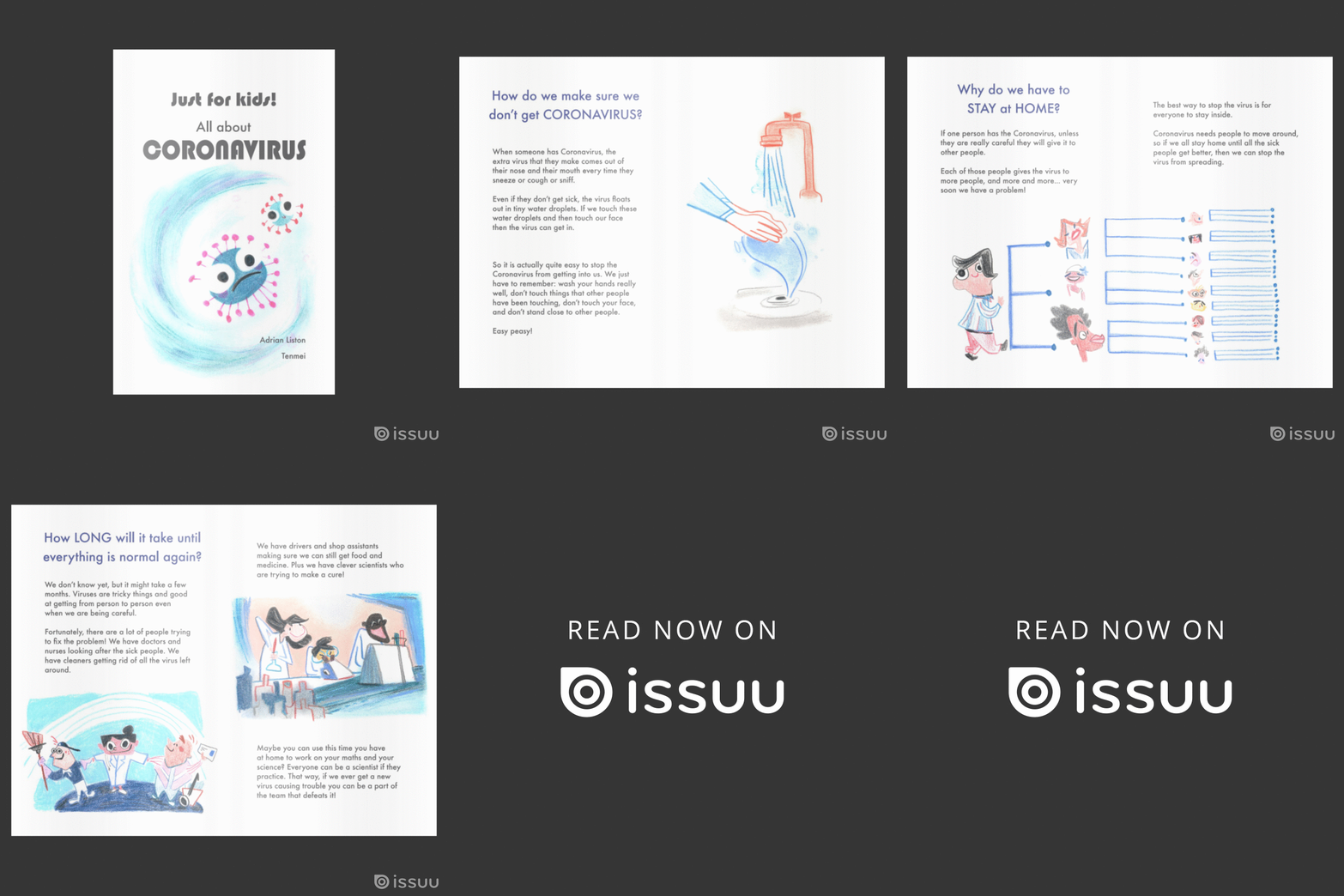
Just for Kids! All about Coronavirus

Read online for free

Print your own copy

Archive
Aila Biotech

Learn about our spin-off, Aila Biotech!

Entries in science careers (103)

Thursday
Jun252020

Training the PhD supervisors

I just completed another "training the PhD supervisors" course, in anticipation of my first Cambridge PhD students. I have a few thoughts on training supervisors, but first my credentials and context: 

1. Unlike most science professors, I took formal training in higher education, through a two year part-time Graduate Certificate program, and have published on PhD training.

2. 26 PhD students as supervisor (16) or co-supervisor (10). Of these, 18 graduations, 6 students still in progress and 2 drop-outs. Some easy experiences, where the students flew though. Some wonderful experiences, where I really got to help the student grow and flourish. Some steep learning curves, where the student and I took longer to get it together, but ultimately we both learned from the experience and the student suceeded. Some nightmares, that had me on the edge of quitting and occasionally still give me insomnia. I am a better supervisor today than I was 10 years ago, and hopefully I will be a better PhD supervisor in 10 years than I am today.

3. I see the PhD as a program where you create the environment that gives the student the opportunity to grow. This is difficult, since it involves understanding the student and pushing them just the right amount to stimulate them without intimidating them. The PhD for me is a highly versatile program, and I am happy for it to steer towards many different outcomes based on what the student is aiming for (academia, industry, etc).

So, my thoughts on training programs for PhD supervisors

First, they are necessary. The messages end up being fairly simple. Remember your PhD student is a person as well as a student. Learn that your student has different needs and expectations that you did as a PhD student. Learn to listen to their expectations, learn to be explicit in your expectations, be prepared to discuss and compromise. Document and revisit discussions. Learn the boundaries of reasonable expectations on both sides. Learn when to bring in extra help, learn where that help can come from. While these messages are simple, for many PhD supervisors it will be the first time they've explicitly heard them, and often new supervisors rely excessively on the lessons of their own n=1 PhD. 

This is the raison d'être of these training programs, and the central work is typically done well. There are several common failings, however:

1. Pedagogy has a teaching problem. Education is an advanced academic field, with a highly specialised language, just like other fields. Unfortunately, many education experts use this language when training PhD supervisors. It is a major turn-off, especially to STEM academics, where even common humanities terms can be opaque or even just mystifying. Most supervisors are going to get less than one undergrad credit worth of education training - the use of specialist language is unnecessary and a barrier to concept uptake. I fully acknowledge that STEM disciplines have the same language barrier. I hope that one day there is a concerted effort to bring knowledge from STEM into humanities - and at that point we will need to learn the language of humanities to effectively communicate. But during supervisor training the onus is clearly on the trainer to use discipline-neutral language.

2. Humanities and STEM are just too different. The PhD programs are so different, in style, outcome and supervision, that examples and advice end up being so generic it is of little value, or it jars completely with one of the fields. Just split up these training courses into humanities and STEM, replicate the common content and specialise the field-specific content. 

3. Supervisor training programs are too reactionary. A common mistake for new supervisors is to focus on correcting problems that they experienced during their own PhD. It can result in them being blindsided by different challenges. Ironically, the very classes that teach this are often guilty of the same problem. These courses are designed around the failings of current senior faculty. It is almost "what do we wish our senior lecturers had been taught 20 years ago?" in content and context. In STEM, the biggest failure in the senior supervisor population is the "sink or swim" mentality, which essentially assumes that any student who struggles is not cut out for a PhD (i.e., the failure is entirely in the student). This is demonstrably incorrect and propogates major problems of inequality. However, while this flaw is common in senior supervisors, it is becoming extremely rare in junior supervisors. When given problem examples, junior supervisors tend to first assume the failures are entirely in the supervisor. I have seen more issues arise from junior supervisors trying to be a friend to their students, or over-committing their time to a single student, then I have from junior supervisors neglecting their students. This is not to say that neglect is not a problem - it is, and needs to be addressed. However training courses for junior supervisors should better reflect the problems that are common in junior supervisors. 

4. Training programs are less valuable because they are siloed. This training is focused on the well-being of the student, and is essentially dedicated entirely to situations where the student has a problem that can be fixed by behaviour-change in the supervisor. We know, however, that junior faculty are under enormous stress, rife with anxiety. One of the biggest sources of stress can be the very rare cases of problem students. This situation, of a problem that requires behaviour-change in the student, is almost entirely neglected in supervisor training. We are trying to fix one side of the equation in this training, and the other side is often entirely neglected or dealt with in a generic "stress resilience" training course (which also assumes the flaw is in the faculty not being able to deal with the stress). What we need is integrated training. Pitch us the same problem scenario twice, but with different missing context. Walk through the problem scenario with missing context A, where you need to change. Walk through the problem scenario with missing context B, where the student needs to change. Discuss how to identify developing problems, how to reflect on whether you are dealing with a context A or context B issue, and what practical steps to take in each context. I really dislike the problem scenarios where we are expected to take a one paragraph description at face value - real lab problems are never that simple, and always involve looking at a problem from multiple perspectives. Real solutions always involve trade-offs. Let's not pretend to junior supervisors that they will be in a situation where they can just invest limitless time - there needs to be hard barriers to stop work-life imbalance on their side. Let's also not pretend that a supervisor-student relationship exists in isolation - it has impacts on the entire lab, and trade-offs are always required. Perhaps this comes from a STEM vs humanities divide, but I see the concept of the team/lab almost entirely neglected in problem scenarios and trouble-shooting.

Finally, a little self-reflection. I would give this particular training course a 9/10 - probably the best I've been through. And yet 90% of what I wrote is a criticism. Occupational hazard? I think in STEM we move very quickly on from the success to trying to fix the failures. I know that when I run evaluations I need to force myself to stop, and say "well done on X, Y and Z. These are important. Congratulations. Now let's talk about A, B and C, which need some improvement...... Again, well done on X, Y and Z."

Thursday
Jun182020

Position open for a data scientist

We have an exciting opportunity for a post-doc or staff scientist to join the Liston lab at The Babraham Institute. The role will be responsible for leading the development of data analysis methods and bioinformatics pipelines for immunology projects. This is a perfect position for a computationally-orientated scientist who wishes to model real biological data and is willing to learn immunology.

Applicants will have a PhD in mathematics, computer science or bioinformatics. For those with additional postdoctoral experience, a more senior position with added responsibilities is available. Applicants from diverse academic backgrounds are encouraged to apply, immunology experience is not essential. Experience at being embedded in a wet-lab environment, prior work on flow cytometry or single-cell RNA-seq data, or experience in machine learning will all be considered strong assets.

This job is ideal for a strong mathematical candidate who wants to apply their knowledge to biological problems. The successful candidate will work as part of a wet/dry mixed lab, develop novel tools, analyse data, create mathematical models and aid in the design of experiments to test those models. The job has potential career development into a long-term staff scientist, or would suit candidates looking to develop skills for an independent position.

The Liston lab is a fun, international and multi-disciplinary environment, which welcomes diversity and supports the career growth of lab members. 

Wednesday
Jun032020

What we are doing during the COVID-19 pandemic

This is a strange time for any workplace. People suddenly working from home, large changes in job duties, some people left without much to do while others are expected to manage whole new realms of bureaucracy while also continuing their full-time job. For us, as an immunology lab, this pandemic has an added dimension of peculiarity: our work is directly relevant to the ongoing situation.

Looking back on how we dealt with the outbreak, we were ahead of the curve. We put in place strict social distancing and work-from-home measures well before our institutes / government did (and, I would argue as an immunologist, our lab rules were more science-based than those later imposed on us). We also started a public education program on COVID-19, with an interactive Virus Outbreak simulator, an illustrated series translating scientific  articles into lay language and even released a kid's book explaining Coronavirus (with special thanks to lab members Dr Teresa Prezzemolo, Julika Neumann and Dr Mathijs Willemsen for translating this into different languages).

We also had lab members head back to the clinic to help with the capacity issues created by COVID-19. Dr Frederik Staels and Dr Erika Van Nieuwenhove suspended research to increase their clinical duties, and Dr Stephanie Humblet-Baron and Dr Mathijs Willemsen were on-call in case the system was overwhelmed.

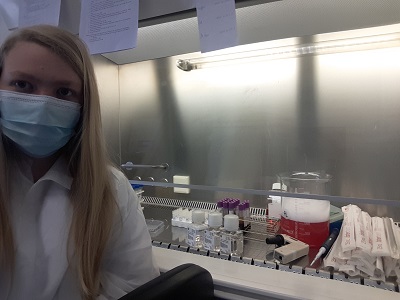
Silke Janssen, processing patient blood

Our lab never completely shut-down though - we had important work that needed to be done. I'd like to call out Dr Susan Schlenner, Dr James Dooley and Dr Lubna Kouser who led the unglamorous but key administration on securing the safety of team members who had to be in the lab. Our Leuven lab was central to the processing of clinical COVID-19 samples. We usually think of clinical trials being run by MDs, but the work does not end after the blood is collected. I really want to call out the key contributions of Silke Janssens and Dr Teresa Prezzemolo. Without them, coming in all day, every day to process blood samples, clinical research of COVID-19 would have been crippled.

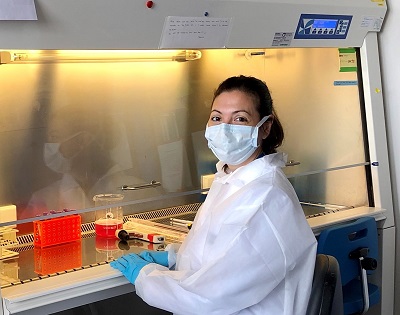
Dr Teresa Prezzemolo in the L2 labOur team, lead by Dr Stephanie Humblet-Baron, also analysed the samples prepared. We performed an ultra-high parameter analysis (far beyond state-of-the-art hospital diagnostics) of the T cell phenotype of COVID-19 patients: months of work from Dr Teresa Prezzemolo, Silke Janssens, Julika Neumann and Dr Mathijs Willemsen. Data analysis by Julika Neumann, Dr Carlos Roca, Dr Oliver Burton and Dr Stephanie Humblet-Baron identified a novel link between IL-10-producing Tregs and COVID-19 severity. We are now following this up to see if the link is useful as a biomarker or even is mechanistic in disease program. We have made our data an open resource (link), allowing other groups around the work to analyse our work. We are continuing to follow these patients and will soon have more and more information about why some patients remain completely healthy and others develop severe, even fatal, disease.

Dr Dooley and Dr Kouser (pre-COVID-19)We are not just clinical immunologists - we are also basic research immunologists. Mysterious virus triggering immune-mediated destruction of the tissue? We can deal with that. The whole lab contributed to the design of a new potential therapeutic, but I would especially like to call out the contributions of Dr James Dooley, Dr Oliver Burton, Dr Lubna Kouser and Fran Naranjo. Manufacturing is now complete and we are moving to pre-clinical testing. Hopefully we have a vaccine for SARS2 before our treatment is complete, but it is designed to deal with an unknown SARS3 equally well.

Suffice it to say, we have been as busy as we've ever been, and we will likely remain just as busy well after COVID-19 stops making the headlines. Which brings me to my final plea. Don't forget about scientific research. Unsung heroes during the pandemic, our staff are putting in an enormous effort. And yet we face an incredibly uncertain funding situation. Universities and research institutes have taken an enormous financial blow with this pandemic, and unless governments step in with a large financial rescue package, those scientific research staff who got us through the pandemic are going to be laid off in huge numbers. Even if you don't care about the moral imperative of looking after the people who stepped up when we needed them, there will be a SARS3 or novel flu pandemic in the future. We need to secure the research infrastructure to combat them right now. Science is not a factory that can be switched on and off at will - we need to maintain research excellence, scientific equipment and most of all key staff contracts over the long-term.

Monday
May182020

Welcome to a PhD

This recent twitter thread from a first-gen graduate asking about a PhD got me thinking. As a first-gen graduate myself, what advice would I give to someone starting a PhD? The below is tailored towards a biomed PhD in the UK/EU/Australian systems, but some points are more generalisable:

First, getting into a PhD program is tough. You've made it, congratulations! By definition you have the intellectual ability to finish. Never doubt that. That said, you will doubt it. Especially at the 3-6 month period and at ~2 years in. That is normal. Even though the people around you look confident, they all went through a similar period. 

Second, it is your PhD, but the lab's project. You should aim to become the intellectual leader of the project after around a year, but always lead with humility. Others around you will always know more than you on specific techniques or domain knowledge. Being the leader doesn't mean be the boss. It means being the person who makes sure that things are on track, who takes responsibility for keeping up with the literature and following up with people who are part of the team.

Ask for advice, and listen to that advice. Take particular note when it comes from experience. Don't be that student who ignores technicians. When a tech is telling you something, listen. If your supervisor tells you something, listen. Feel free to disagree, but first listen. If someone suggests a protocol for an experiment, do not go back to them for help until you have actually followed their protocol word for word. Don't change protocols that work until you've got a lot more experience. Include every control that is suggested, even the ones you don't think are necessary.

Being a PI is a tough job, very time-demanding. So use their time wisely. Prep before a meeting, take notes during, follow-up. If you can answer a question via a quick google search or conversation with another lab member, do that instead of knocking on their door. A PI can be a valuable asset to you if you use their time wisely. If you start wasting their time they will schedule you out,

The lab environment can be a pressure-cooker of stress. Experiments don't work, trouble-shooting is horrible, publication can be nightmarish. At its best, the shared adversity will create unbreakable bonds between lab members. To make this happen, be considerate, be kind, forgive. Be the team member who helps out. Smile when someone frowns - they may have just had the most horrid day. Soon enough you have a day where you snap or frown - treat them the way you would like to be treated on your worst. Especially keep in mind that science is highly international and multi-cultural, and people may not mean things the way you perceive them (and vice versa). 

At the start, get into the lab and learn how it works. Where the tip-boxes go, who refills them and makes up new solutions, how plastics get ordered. Ask the lab manager or senior tech what you can do to help out. There are no magic fairies - every task is done by the team. If you leave the centrifuge messy, use the last reagent without ordering more, you will annoy people. If you clog up their personal pipettes and don't tell anyone, you will really annoy people. Be a good lab citizen.

The first six months is basically you learning how to be in the lab, reading the basic literature and just learning how to do the techniques. You won't actually make any advances - this is all on-the-job training.

Don't hide mistakes. You are going to make mistakes. You are going to make mistakes that will cost your monthly rent's worth in grant money. I remember the horror of breaking a haemocytometer during my first week in the lab. $500 at a time where that was an unbelievable amount of money to me. You make make mistakes that cost your annual salary's worth. Own them. Admit to them. Don't make them again. Never blame others for your mistake. Someone breaking the centrifuge is bad, but if I know they will never do it again I move on. If they blamed someone else for leaving it unbalanced (while they didn't check) then I worry that they haven't taken responsibility and are more likely to make the same expensive mistake again.

Six months in, and you are ready to go solo. Things that worked when you were shown how stop working. You will feel like a failure. It is tough, you will doubt yourself. You will look at senior students and think you will never be that good. You will, it just takes time. Here first-gen graduates have an advantage. They don't expect things to come easy to them, so they grit your teeth, try again, fail again and try again. A lot of success in science comes from having the personality to be able to deal with failure, over and over again. 
It starts working, you get results! Now you need to switch techniques, and you go through the same process. Much of the next year is this in repeat. You are now a real scientist, but you won't feel like you have made any actual progress on your PhD. Your lab mates try to pick you up, but you doubt. Again, this is normal. These are the "PhD blues". You might think about other careers, do a few training courses, lose motivation to go to work. This period can drag on, but once you get back into the lab and push, things will crack.

You are now the senior PhD student that juniors look at. They see you as calm and capable. You have become a data machine. In about six months you pump out 90% of the data of your PhD. At the same time, you probably see yourself as a bit of a fraud: you know you can handle the day-to-day of the lab, but you doubt you can handle the intellectual side still.  Your supervisor now becomes your key asset, probably for the first time, as you start to write up. 

Don't spend much time on your first draft, it will be rubbish anyway. Everyone's is. Just write it up and get feedback. Just like any technique, writing is a skill that you will learn, you just have to be willing to give it a shot, get feedback, and try again. This means when you your draft back full of revisions, don't just accept the changes. Try to understand them. What change did you PI make, and could you incorporate that strategy yourself next time? In particular, read papers while writing. Compare your paper to published papers, sentence by sentence to see if your work looks like the real thing. What do figure legends have in your field? Does your draft figure legend have all of these attributes? Remember you are the paper lead, but it is a consensus document. Be generous on coauthorship, and remember who helped you out early on. It means a lot to people to be acknowledged, and it doesn't hurt you to have extra authors on your paper.

Publication. Ah, this is a horrible ordeal. You will get rejected multiple times, it will feel rubbish. Flip that paper to the next journal and don't take it personally. Don't dwell too much on the comments, the next reviewers may be completely different. If your paper is given a "major revision" - congratulations! That is actually really good news. Now you need to do all the experiments that the reviewers asked that are at all possible. Yes, you could argue the point, but save this for the cases where the experiment is impossible. It is much better to deal with a major revision than to start fresh with a new journal. At the end, you may feel more exhaustion and relief that the paper is off your plate, rather than actual satisfaction. This is (unfortunatey) normal. So make sure you celebrate every intermediate stage (submission, going out to review, major revisions coming back, etc). 

Remember you don't actually need to publish to graduate (in the UK or Australia, in much of the EU you do, but there is a journal home for every paper). You just need to produce a body of work suitable for publication. Like your paper, just push out the first thesis draft quick and dirty. It is a formality, nothing more. Your contribution is in your papers, while your thesis will be read by the jury only, and then gather dust on the shelves somewhere. 

Congratulations! You have a PhD. The highest degree possible. You are now an expert in your chosen field (although we all have more to learn!). You have many, many good career options available to you. A PhD in biomedical sciences is a gateway to so many interesting careers. Go down a pathway that looks interesting to you, and if it doesn't work out, pick a new path. The world is your oyster!

Friday
Apr102020

Position available for a cell biologist in the Liston lab

Due to COVID-19 we have extended the applications for this position for another month.

This is a great opportunity for a scientist to work on an exciting diabetes project in the Leuven lab. Pure cell biology, so we welcome applications from beyond immunology or endocrinology! We have both a research technician and post-doc position available, depending on the experience / background of the applicant. If you are interested, please apply!

Monday
Mar232020

Lab tech position

Job opportunity: we need a junior lab technician at the University of Leuven to be trained for PBMC isolation and flow cytometry analysis, to place a key role in clinical trials. We are after someone who is willing to listen and takes their work seriously. If you already know flow cytometry, great, if not, we will train you. Apply here, and take on a job that matters. 


Monday
Oct282019

Interview with Louisa Wood

 Where were you and what were you doing before you joined the Institute?

I was a professor at the University of Leuven and VIB, in Belgium. I set up my lab there in 2009, and spent the last 10 years growing a research program and setting up two core facilities. 

What has the relocation experience been like so far? Best bit and worse bit?

I might plead the fifth there! Problems are for solving, not complaining about. 

What’s your research about?

I've always admired scientists who chose one problem and spend a career on solving it at a deeper and deeper level, but that isn't my personality. I love the creative process, hearing about a problem and them coming up with a spark, a creative way to tackle that problem. It has been a fun way for me to work, and we've made major contributions in different fields - basic immunology, clinical immunology, endocrinology, microbiology, neuroscience, genetics, bioinformatics - but I've generally avoiding asking the follow-up questions. I think as my career has matured, I might be ready to settle down with that one special question through: what is the adaptive immune system doing in the tissues? 

Any advice from what you’ve learned from setting up your own lab?

There are different routes to success, and you need to find one that works for you. From my perspective, the key to my success (survival? I guess they mean a similar thing in academia) has been rapidly building a diverse portfolio. Key here was my first hire - James Dooley (still with me 10 years later, having relocated over to the Babraham with me). He came on as an experienced research assistant from a small lab (an amazing training ground, since techs in small labs are expected to know how to do everything). Having someone that I could trust in the lab let me write grants. I wrote and wrote and wrote - I brought in 22 grants and 19 fellowships over my 10 years in Belgium, and must have submitted one a month on average. The whole time I saw James develop as a lab manager and then a senior scientist, and saw that he was actually much better in the lab than I ever would be, so the relationship turned into a partnership, with each of us taking the lead in our area of expertise. So I guess the key advice would be to hire James - but he already has a job, so hands off! Seriously though, hire the best, give them your trust and support, and let them take on responsibilities as they grow. It means making a serious commitment to their careers: senior staff grow more valuable every year, and this should be reflected in their salary and job stability.  

Do  you  have  any  words  of  wisdom  for  those  starting  off  in  a  scientific career? What do you know now that you wish you’d known then?

First, attitude matters when you hire someone. Unfortunately, not everyone is in science because they care about it. I've had people with very competent CVs join my lab for the wrong reason, like wanting to get a PhD. Ultimately, if you don't really care about the science, you won't be a good scientist. Skills can be taught, but I've never found a good way to mentor someone who didn't have a positive attitude, so my advice to a younger me would be: when you see those warning signs, give that person their notice. Attitude also matters in the other direction: when we needed to hire a mouse technician we passed over people with experience to take on Jeason Haughton, a Jamaican life guard with no experience in science at all. Why? Because we could tell that he was ready to listen, ready to learn and ready to work. Jeason has now been with me for 6 years, and there was a long line-up from other labs desperate to take him on when I moved over to Cambridge!

Second, peer review is over-rated. There is a degree of "reviewer roulette" at play that you can't take too personally. Great grants get rejected all the time. My first small grant to a Belgian funder was rejected - a few months later I submitted more-or-less the same thing to the ERC and gained a €1.5m grant that led to great papers. Papers will get rejected at one journal, and then accepted at a better journal. Why? Reviewer roulette. Oh, there have certainly been occasions when a reviewer's suggestions improved a paper, but more often it is just extra stuff for the supplementary material. My advice is to accept it is a game, and win through numbers. Why invest all your emotional energy into one grant, when you can write four or five? If a paper is rejected from one journal, resubmit to the next that day. Start juggling with as many balls as you can competently handle (the trick is working out how many that is), and make sure they are always in motion. 

Who has inspired you? Why?

David Attenborough. From the youngest age, watching his documentaries guided me into thinking like a scientist. To try to understand life through the prism of evolution, to understand living systems as complex positive and negative feedback loops. I still find that I bring a very ecological style of thinking to understanding immunology. He also shaped by ethics and my politics - because of him, I am a lifelong vegetarian and ardent environmentalist. For an inspiration from an immunologist, I've also admired the work of Gitta Stockinger (now at the Crick). Someone who is prepared to do a deep-dive into a question, and not just crop off the easy big hits: her work on Th17 cells and the aryl hyrdocarbon receptor are some of the best reads in the field. I'd also add: I think it is important to tell people how much you admire them! Science is a tough business, and even the most senior people deserve positive affirmation. I had the pleasure of successfully nominating Gitta for an EFIS-IL award in 2017, and it was a pleasure to introduce her award plenary and describe her to everyone as one of my scientific heroes. Just recently I sent a letter to Sir David, thanking him for his influence (and received a nice reply too). 

What has been your proudest personal and/or scientific achievement?

Here I would bring up two post-doctoral fellows who joined my lab back in Belgium - Stephanie Humblet-Baron (joined 2010, as her first post-doc) and Susan Schlenner (joined 2012, as her second post-doc). Both are amazing scientists, Stephanie as a clinical/translational immunologist and Susan as a molecular immunologist, who took on slow-burning projects. For Stephanie, it was six years between her starting in my lab and getting her first paper - but since then a big hit every year! Susan not only started ambitious projects but also set up a CrispR facility at the University of Leuven - a job that has helped many labs, but is not exactly a career builder. In both of them I saw future leaders. They were already at an amazing level scientifically, so my mentorship was to help build their understanding of how a lab works, strategies for writing grants and papers, discussions on how to manage staff, advice on how to build and maintain a portfolio of projects, and guidance through the tenure-track application process. So among my proudest scientific moments were when they were both made tenure-track professors at the University of Leuven - Susan in 2017 and Stephanie in 2019. Two outstanding scientists from my lab who are now independent. I don't think I could have left Belgium without knowing that my lab and Core facilities there would continue to flourish, now under their leadership.

Saturday
Oct262019

PhD opportunity in the Liston lab!

Are you interested in a PhD in neuroimmunology? Want to find out how to harness the power of the immune system to cure traumatic brain injury? Check out our PhD position here. It is a rare chance to join a fantastic international team, and to learn to do high level science in a supportive and caring environment.

A successful candidate will be:

  • passionate about science and the project
  • experienced at failure, with a track-record in the resilience needed to pick yourself up and try again
  • willing to be wrong, willing to learn, willing to improve
  • driven to make a difference, discover new biology or move a promising therapeutic to the next stage
  • creative and imaginative
  • detail-orientated and reliable

The successful candidate does not need:

  • experience at immunology or neuroscience. You are here to learn, not start as an expert!
  • technical experience in X, Y or Z - as above
  • a perfect CV. I'm interested in seeing that you know how to succeed in the face of adversity

 If you are submitting an application, consider a co-application to a Cambridge College, such as Peterhouse.

Tuesday
Aug202019

Scientific heroes

My first scientific hero was Sir David Attenborough. From the youngest age, his documentaries guided me into thinking like a scientist. To try to understand life through the prism of evolution, to understand living systems as complex positive and negative feedback loops. David Attenborough inspired me to become a biologist, and shaped my politics and my ethics. I recently wrote to him to thank him for the profound effect he has had on me, and was incredibly pleased to receive a letter from him this week. #tellyourheroes
Sunday
Jul282019

When should I apply for a fellowship?

To develop an academic career in research you need to develop two sides of your CV - one is your publication record and the other is a record of prizes, fellowships and grants. Publications are hard. Years of research and a brutal revision process make accumulating a publication record slow and painful. Prizes, fellowships and grants are, in principle, easier. You write up a proposal and submit. Often you can even submit the same proposal in multiple places. It is very rare that prizes are awarded without you applying for it, so sending out a lot of applications just makes sense.

For poster prizes, departmental awards, travel grants, the equation is quite simple: apply for them. There are a lot of small prizes that are usually under-subscribed, they can earn you a little money and these small prizes build up to greater things. For fellowships, on the other hand, I have started to lean in the other direction. I used to suggest that all post-docs apply for a fellowship - if successful, it is a nice income and a highlight in your CV, and if unsuccessful, well... it is good practice. Now, however, I tend to discourage fellowship applications very early on in the career. Newly graduated PhD students are often very keen to apply for fellowships, and there are so many opportunities that you can easily spend a year applying for one after the other.

The question that you need to ask yourself is whether applying for fellowships is a a good investment of time. A successful fellowship application normally merges a great idea (the science) and a proven record to deliver that idea (most importantly, your publication record). A lot of post-docs make the mistake of applying for fellowships too early, before their publication record is ready to support it. It is easy to think that there is no cost to doing so, but applying for fellowships takes a non-trivial amount of time. As a scientist you always need to weigh up the opportunity cost: time spent on fellowships is time not spent on experiments. There are times when applying for a fellowship is sensible, and other times when you are better off investing all of your energy in experiments (building that publication record for future fellowships). Here are a few factors that you can consider:

Factors that should encourage you to apply for fellowships:

  • You are a senior post-doc looking to become independent
  • The fellowship allows you to take a key mobility step (eg, Marie Curie to return to Europe)
  • You just published a highlight paper
  • Your PI says you need a fellowship to stay in the lab (but consider moving labs instead)
  • You don't expect your CV to improve in the next year
  • You will not be eligible next year

Factors that should discourage you from applying for fellowships:

  • Your PI has a grant that covers the full period of your project
  • You have a top story cooking (it deserves all your attention!)
  • Your publication record is relatively thin, without any highlight papers (but watch out for being excessively self-critical! A neutral faculty member is a useful independent judge)
  • You expect your CV to improve in the next year

My suggestion: rather than automatically write a fellowship, because that is what post-docs do, carefully consider the factors above, consult with faculty and then rationally decide where to invest your effort. Make sure that you don't talk yourself out of applying just for reasons of self-confidence, but also don't be afraid to concentrate on the science this year instead of applying, to put yourself in a better position to apply next year.